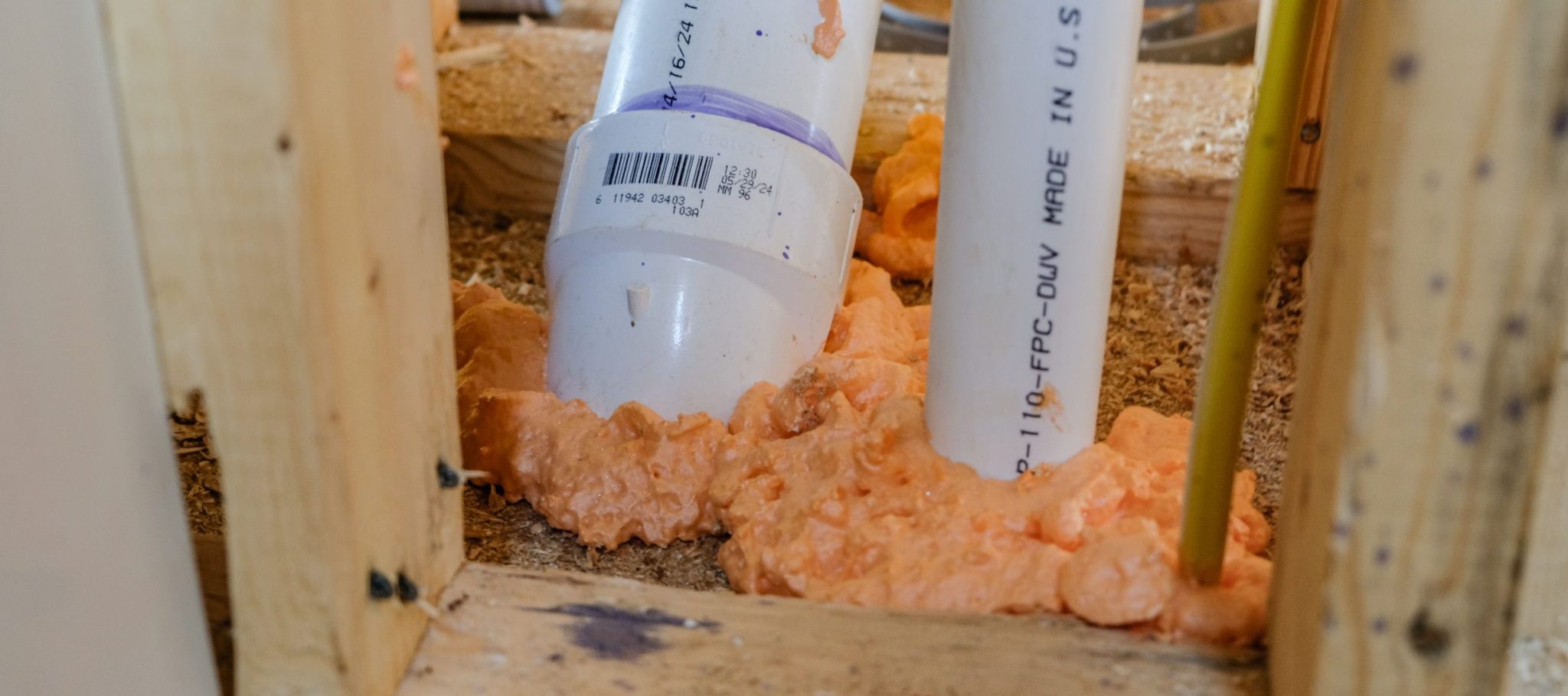
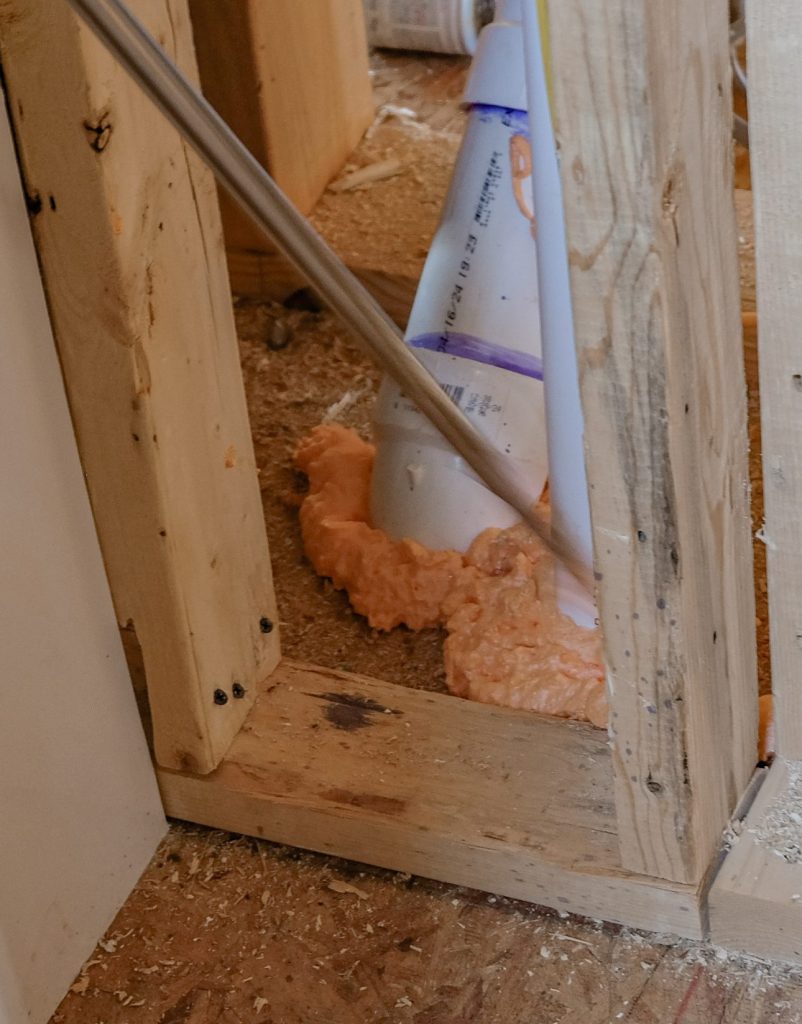
Canned insulating foam sealants have grown rapidly in popularity over the past 30 years, driven by rising energy-efficiency standards and increasingly stringent residential energy codes. They are most used to seal cavities around windows, doors, and framing joints, filling gaps and cracks that would otherwise allow unwanted air infiltration.
Why Fireblocking Matters
Although foam sealants are widely used to improve building energy performance, their flammability has made enforcement of fireblocking code requirements a major life-safety focus since the late 1990s. This focus has centered on the ongoing debate between using traditional ASTM E136 noncombustible caulks and newer, approved fireblocking foam sealants tested to a modified ASTM E814 fire standard.
Fireblocking Code History & Updates
Legacy Codes
Fireblocking required noncombustible materials (ASTM E136 tested)
Covered soffits, stair runs, chimneys, vent/pipe/duct penetrations
IRC Language Revision
Code changed “approved noncombustible material” → “approved material”
Opened use of ICC-evaluated fireblocking foams in wood-frame homes
ICC-ES AC546 Finalized
Foam must meet surface-burning limits (ASTM E84/UL 723)
Requires comparative fire testing (modified ASTM E814/UL 1479)
Current Practice & Verification
Only tested & documented foam ensures fireblocking integrity
Untested pink/orange foam is unsafe

Before the International Residential Code (IRC) emerged in the early 2000s, legacy building codes specified exactly which wood, insulation, drywall, and cement board materials could be used to meet fireblocking requirements for soffits, drop and cove ceilings, and the tops and bottoms of stair runs. They also mandated noncombustible materials (ASTM E136) for fireblocking around chimneys, fireplaces, and penetrations for vents, pipes, and ducts at floor and ceiling levels.
In 2006, after successful lobbying from the polyurethane foam industry, the IRC revised this language. Fireblocking Code Section R301.2.11 Item 4 was changed from “approved noncombustible material” to simply “approved material,” opening the door for ICC-evaluated and other third-party–tested fireblocking foam sealants (tested to a modified ASTM E814) to be used for fireblocking penetrations in non-rated Type V-B wood-frame residential construction.
Even with this update, state and local code officials retained discretion to decide whether to allow traditional ASTM E136 noncombustible fireblocking caulks or ICC-ES/UL-listed, ASTM E814-tested fireblocking foams. These decisions frequently drew on legacy code language as well as the underlying intent of fireblocking: to resist the free passage of flame and products of combustion.
The Risk of Untested Foam Sealants
Most foam sealants are highly flammable and can produce heavy smoke and toxic gases when burned. The core purpose of fireblocking requirements is to slow the movement of fire and force combustion to burn through individual framing members before it can reach adjacent cavities. This passive protection delays full fire involvement, providing critical minutes for safe egress and allowing occupants more time to escape.
"The integrity of fireblocks shall be maintained" - is the definitive code provision underscoring that fireblocking materials must perform “equal to or greater than” the burn time of the surrounding wood substrates.
Section R302.11.2 of the 2021 International Residential Code
Section R302.11.2 of the 2021 IRC: “The integrity of fireblocks shall be maintained” – is the definitive code provision underscoring that fireblocking materials must perform “equal to or greater than” the burn time of the surrounding wood substrates. Typical insulating foams are highly combustible and cannot outlast the fire exposure of the wood they are installed alongside. Any manufacturer making such claims without supporting test data cannot demonstrate the fireblocking integrity required for critical life-safety applications.
AC546 Compliance Requirements
In February 2023, the ICC-ES hearing finalized AC546 as the acceptance criteria for spray-applied foam plastics used to maintain the integrity of wood fireblocking. To comply with AC546, a foam sealant must be tested for surface-burning characteristics and demonstrate a maximum flame-spread index of 75 and a maximum smoke-developed index of 450 per ASTM E84 or UL 723. The material must also undergo comparative fire testing to prove it can maintain fireblocking integrity using ASTM E814 or UL 1479, with modified F and T ratings and the hose-stream test removed.
AC546 Testing Requirements Breakdown
Test Category | Standard | Required Criteria | What It Verifies | Required for AC546 Compliance |
|---|---|---|---|---|
Surface-Burning Characteristics | ASTM E84 / UL 723 | Flame spread index ≤ 75 Smoke developed index ≤ 450 | Limits flame spread and smoke production when exposed to fire | Yes |
Comparative Fire Resistance Testing | ASTM E814 / UL 1479 | Modified F and T ratings Hose-stream test removed | Demonstrates material can maintain fireblocking integrity comparable to surrounding wood framing | Yes |
ICC-ES Evaluation Report or 3rd-Party ER | ICC-ES AC546 | Successful completion of both surface-burning and comparative fire tests | Confirms suitability of foam plastics for maintaining wood fireblocking integrity | Yes |
Product Identification | Manufacturer documentation | Clear product name, model, and traceability | Allows inspectors to verify installed material matches tested product | Yes |
Installation Instructions | Manufacturer documentation | Instructions consistent with tested conditions | Ensures field installation matches tested performance | Yes |
Foam Color | Visual identification only | Pink, orange, or other | No performance or compliance validation | No |
Documentation & Verification
As part of the quality documentation and validation required for proper inspection and enforcement of the foam sealants that have met the fireblocking code requirements of AC546, manufacturers of the foam fireblocking sealants should provide an ICC-ES evaluation report or 3rd party testing report that includes basic information including product description, installation procedures, and identification information.
A foam sealant bearing a UL marking for Flame Spread characteristics for ASTM E84 / UL 723 is not the acceptance criteria for a foam fireblocking sealant.
For a fireblocking foam to comply with the IRC fireblocking code requirements for section R302.11.2 item 4, the product must have a UL classified ASTM E84 / UL 723 Surface Buring Characteristics listing or similar 3rd party tested documentation and an ICC-ES evaluation report or (3rd party ER testing report) validating the foam plastic materials comparative fire resistance testing.
Selling, using, or allowing a pink or orange colored foam without proper testing documentation is a risky and negligent decision that could potentially affect the outcome of a human life. Furthermore, a foam sealant bearing a UL marking for Flame Spread characteristics for ASTM E84/ UL 723 is not the acceptance criteria for a foam fireblocking sealant without the ICC-ES or 3rd party Comparative Fire Testing Documentation needed to validate the foam sealant has the fireblocking integrity to resist the passage of flame and free products of combustion. Without this evidence or testing documentation, the material is just a pink or orange colored foam plastic that could potentially accelerate the fire rather than inhibit the spread of fire to other areas of the building.
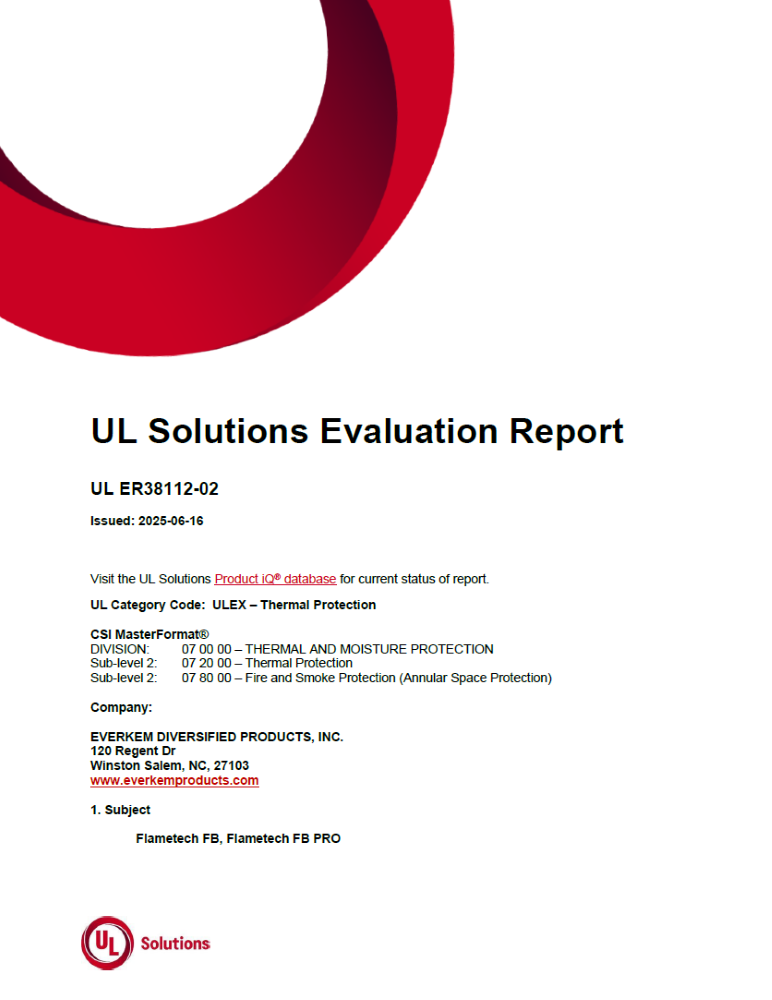
Click here to view the full UL Solutions Evaluation Report for our FlameTech FB Fireblock Foam.
Life-Safety Implications
Single-family, wood-frame residential fires account for a significant number of fatalities, and every second is critical for safe egress. Using the proper materials as passive fire protection and meeting fireblocking code requirements is essential to ensuring minimum life-safety standards. Verifying manufacturer claims and confirming materials with testing documentation provides basic assurance that our buildings comply with code and contribute to fire safety and fireblocking integrity for future generations.
Everkem Diversified Products offers a premier line of fireblocking caulks and foam sealants, tested to meet and exceed building code requirements while maintaining the fireblocking integrity specified by the International Residential Code.
WANT TO LEARN MORE ABOUT FIREBLOCKING FOAM SEALANTS?
Canned insulating foam sealants have grown rapidly in popularity over the past 30 years, driven by rising energy-efficiency standards and increasingly stringent residential energy codes. They are most used to seal cavities around windows, doors, and framing joints, filling gaps and cracks that would otherwise allow unwanted air infiltration.
Why Fireblocking Matters
Although foam sealants are widely used to improve building energy performance, their flammability has made enforcement of fireblocking code requirements a major life-safety focus since the late 1990s. This focus has centered on the ongoing debate between using traditional ASTM E136 noncombustible caulks and newer, approved fireblocking foam sealants tested to a modified ASTM E814 fire standard.
Fireblocking Code History & Updates
Legacy Codes
Fireblocking required noncombustible materials (ASTM E136 tested)
Covered soffits, stair runs, chimneys, vent/pipe/duct penetrations
IRC Language Revision
Code changed “approved noncombustible material” → “approved material”
Opened use of ICC-evaluated fireblocking foams in wood-frame homes
ICC-ES AC546 Finalized
Foam must meet surface-burning limits (ASTM E84/UL 723)
Requires comparative fire testing (modified ASTM E814/UL 1479)
Current Practice & Verification
Only tested & documented foam ensures fireblocking integrity
Untested pink/orange foam is unsafe

Before the International Residential Code (IRC) emerged in the early 2000s, legacy building codes specified exactly which wood, insulation, drywall, and cement board materials could be used to meet fireblocking requirements for soffits, drop and cove ceilings, and the tops and bottoms of stair runs. They also mandated noncombustible materials (ASTM E136) for fireblocking around chimneys, fireplaces, and penetrations for vents, pipes, and ducts at floor and ceiling levels.
In 2006, after successful lobbying from the polyurethane foam industry, the IRC revised this language. Fireblocking Code Section R301.2.11 Item 4 was changed from “approved noncombustible material” to simply “approved material,” opening the door for ICC-evaluated and other third-party–tested fireblocking foam sealants (tested to a modified ASTM E814) to be used for fireblocking penetrations in non-rated Type V-B wood-frame residential construction.
Even with this update, state and local code officials retained discretion to decide whether to allow traditional ASTM E136 noncombustible fireblocking caulks or ICC-ES/UL-listed, ASTM E814-tested fireblocking foams. These decisions frequently drew on legacy code language as well as the underlying intent of fireblocking: to resist the free passage of flame and products of combustion.
The Risk of Untested Foam Sealants
Most foam sealants are highly flammable and can produce heavy smoke and toxic gases when burned. The core purpose of fireblocking requirements is to slow the movement of fire and force combustion to burn through individual framing members before it can reach adjacent cavities. This passive protection delays full fire involvement, providing critical minutes for safe egress and allowing occupants more time to escape.
"The integrity of fireblocks shall be maintained" - is the definitive code provision underscoring that fireblocking materials must perform “equal to or greater than” the burn time of the surrounding wood substrates.
Section R302.11.2 of the 2021 International Residential Code
Section R302.11.2 of the 2021 IRC: “The integrity of fireblocks shall be maintained” – is the definitive code provision underscoring that fireblocking materials must perform “equal to or greater than” the burn time of the surrounding wood substrates. Typical insulating foams are highly combustible and cannot outlast the fire exposure of the wood they are installed alongside. Any manufacturer making such claims without supporting test data cannot demonstrate the fireblocking integrity required for critical life-safety applications.
AC546 Compliance Requirements
In February 2023, the ICC-ES hearing finalized AC546 as the acceptance criteria for spray-applied foam plastics used to maintain the integrity of wood fireblocking. To comply with AC546, a foam sealant must be tested for surface-burning characteristics and demonstrate a maximum flame-spread index of 75 and a maximum smoke-developed index of 450 per ASTM E84 or UL 723. The material must also undergo comparative fire testing to prove it can maintain fireblocking integrity using ASTM E814 or UL 1479, with modified F and T ratings and the hose-stream test removed.
AC546 Testing Requirements Breakdown
Test Category | Standard | Required Criteria | What It Verifies | Required for AC546 Compliance |
|---|---|---|---|---|
Surface-Burning Characteristics | ASTM E84 / UL 723 | Flame spread index ≤ 75 Smoke developed index ≤ 450 | Limits flame spread and smoke production when exposed to fire | Yes |
Comparative Fire Resistance Testing | ASTM E814 / UL 1479 | Modified F and T ratings Hose-stream test removed | Demonstrates material can maintain fireblocking integrity comparable to surrounding wood framing | Yes |
ICC-ES Evaluation Report or 3rd-Party ER | ICC-ES AC546 | Successful completion of both surface-burning and comparative fire tests | Confirms suitability of foam plastics for maintaining wood fireblocking integrity | Yes |
Product Identification | Manufacturer documentation | Clear product name, model, and traceability | Allows inspectors to verify installed material matches tested product | Yes |
Installation Instructions | Manufacturer documentation | Instructions consistent with tested conditions | Ensures field installation matches tested performance | Yes |
Foam Color | Visual identification only | Pink, orange, or other | No performance or compliance validation | No |
Documentation & Verification
As part of the quality documentation and validation required for proper inspection and enforcement of the foam sealants that have met the fireblocking code requirements of AC546, manufacturers of the foam fireblocking sealants should provide an ICC-ES evaluation report or 3rd party testing report that includes basic information including product description, installation procedures, and identification information.
A foam sealant bearing a UL marking for Flame Spread characteristics for ASTM E84 / UL 723 is not the acceptance criteria for a foam fireblocking sealant.
For a fireblocking foam to comply with the IRC fireblocking code requirements for section R302.11.2 item 4, the product must have a UL classified ASTM E84 / UL 723 Surface Buring Characteristics listing or similar 3rd party tested documentation and an ICC-ES evaluation report or (3rd party ER testing report) validating the foam plastic materials comparative fire resistance testing.
Selling, using, or allowing a pink or orange colored foam without proper testing documentation is a risky and negligent decision that could potentially affect the outcome of a human life. Furthermore, a foam sealant bearing a UL marking for Flame Spread characteristics for ASTM E84/ UL 723 is not the acceptance criteria for a foam fireblocking sealant without the ICC-ES or 3rd party Comparative Fire Testing Documentation needed to validate the foam sealant has the fireblocking integrity to resist the passage of flame and free products of combustion. Without this evidence or testing documentation, the material is just a pink or orange colored foam plastic that could potentially accelerate the fire rather than inhibit the spread of fire to other areas of the building.
Click here to view the full UL Solutions Evaluation Report for our FlameTech FB Fireblock Foam.
Life-Safety Implications
Single-family, wood-frame residential fires account for a significant number of fatalities, and every second is critical for safe egress. Using the proper materials as passive fire protection and meeting fireblocking code requirements is essential to ensuring minimum life-safety standards. Verifying manufacturer claims and confirming materials with testing documentation provides basic assurance that our buildings comply with code and contribute to fire safety and fireblocking integrity for future generations.
Everkem Diversified Products offers a premier line of fireblocking caulks and foam sealants, tested to meet and exceed building code requirements while maintaining the fireblocking integrity specified by the International Residential Code.